
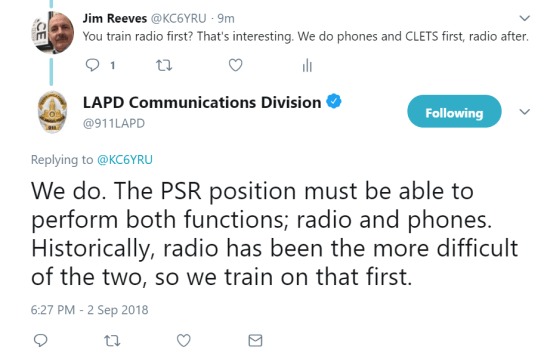
So today on my Twitter feed, @KC6YRU, this popped up from the Communications Division of the Los Angeles Police Department. In case the font is a bit difficult to read, here’s a recap:
“Poll: On average, how long does it take to fully train a new Police Service Representative (Public Safety Dispatcher) at ?”
Choices are 12 weeks, 24 weeks, or 46 weeks. Most respondents got the correct response, 46 weeks.
The next Tweet is what caught my eye.
“Great job and thanks for answering our poll. It takes nearly a full year to train a new PSR (46 weeks average). The training is two phases: Dispatcher (RTO) then Call-taker (EBO). The training consists of classroom, simulations and hands-on. ”
It was interesting to me that LAPD trains on radio first, then on phones. That’s the reverse at what we do at our agency. I Tweeted at LAPDCD:
“You train radio first? That’s interesting. We do phones and CLETS first, radio after.”
They replied moments later (somebody’s working on a weekend):
“We do. The PSR position must be able to perform both functions; radio and phones. Historically, radio has been the more difficult of the two, so we train on that first.”
That’s true for us, as well. The radio will kick your ass. It did mine, and I already knew the area, radio codes, and was an experienced ham radio operator, so I did not experience “mic fright” (a very real thing for new dispatchers). It’s even more difficult for folks who have to learn all of that stuff from scratch.
Our training program has evolved since I was a newbie (24 years ago), from three months of combined radio/phones to a much longer process. Now, we train on phones and paperwork first (there’s a ton of “paperwork” these days, even if most of it is on the computer), then radio. As I was thinking about it, it seemed to me that by doing it this way, we build up the confidence of the trainee that they really can handle whatever gets thrown at them. By the time they get to radio training, they’ve handled a ton of 9-1-1 calls, not to mention the endless routine phone traffic.
LAPD has one of the largest communications divisions in the country, so they know what they’re doing. I wonder what their wash-out rate is, and how long they keep new hires?
My interest in law enforcement dispatching undoubtedly stems from endless reruns of Adam-12 in the late ’60’s and early ’70’s.
“Adam-12, see the man, a 415 in progress. Adam-12, handle code-2”
And of course the opening credits:
“Adam-12, a 211 in progress. Adam-12, handle code-3”
(they never did say where the 211 was located, but the good ole’ Adam-12 car was shown rolling code-3… somewhere.)
 404 Not Found







 JimmieJoe / KC6YRU
When is a zero not a zero?
February 21, 2019
Jim Reeves 9-1-1, commentary, geek, Humor, Personal 9-1-1, 911, 911 dispatch, dispatcher stories, police stories, VIN Leave a comment
For almost 25 years, I’ve been a 9-1-1/law enforcement dispatcher. One task of many in dispatching is to check DMV, DOJ, and national databases for registration and stolen status on vehicles. These checks are usually done by the license plate number, but sometime we have to use the Vehicle Identification Number, also known as the VIN.
From day one of my training, way back in 1994, I was told there are two characters never used in VINs. The letter ‘o’, and the letter ‘i’. This is because they are generally indistinguishable from zeros and ones, especially on VIN plates located on vehicle dashboards or engines. Simple. Every time you see 0 or 1 in a VIN, they are numbers, not letters.
Until yesterday.
More
Share this: