Why does Curiosity have it’s own laser? The truth behind an armed rover.

1 Comment

The official story is one of a modest laser device, used to blast tiny holes in rocks, and analyze the resulting dust and debris with a spectrometer.  This, according to the briefs, will allow scientists to determine the chemical structure of the rocks.  NASA/JPL just released a picture of their first test firing.
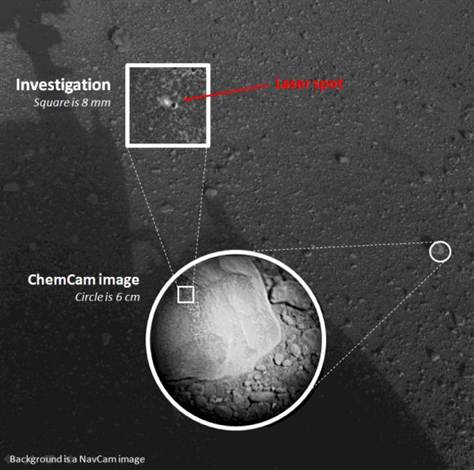
From the looks of the images, you’d think “no big deal. A little tiny hole in a rock.”  The truth, however, is much more sinister.

We all know the government never tells you the complete story about these things.  Remember when spy satellites were all the “top-secret” rage, and they “could read the license plate number on your car”?  Of course, the capabilities were far more than was admitted.  The same thing applies to Curiosity.

A nuclear reactor?  To power a golf cart and a laser pointer? Not bloody likely…
More

Mars isn’t the only place we’ve landed out there!

Leave a comment

The surface of Titan, a satellite of Saturn

Space Cadet JimmieJoe is taking me to task right now.  This is a big thing, and I missed it!

On January 14, 2005, NASA and ESA landed a probe on Titan, one of the moons of Saturn!

I don’t recall being aware of this, at all.  I don’t even know if I’ve seen this picture before, but if I have, I’m fairly certain I would think it was of Mars.  Instead, this is the surface of a satellite orbiting a planet 794 million miles away from us (at it’s closest approach).

I’m thinking, right now, of all the hoopla surrounding the recent landing of the Curiosity on Mars, and marveling that there was not something similar back in 2005.  Yes, the Huygens probe, part of the Cassini mission, only parachuted to the “ground”, and Curiosity did the whole ‘heat shield – parachute – retro rocket – sky crane’ deal, but still…

I missed it!  (hanging head in shame, avoiding the glare of 12 year old Space Cadet JimmieJoe)

Mars, and Titan.  But did you know, they’re not the only two places we’ve set down on.

We’ve landed on another planet, too.

More

7 Minutes of Terror – landing on Mars – by Sky-Crane

1 Comment

This is the best video I’ve seen so far explaining how Curiosity was designed to land.  I’m just amazed that it worked.  Twelve year old Space Cadet Jimmiejoe was bouncing up and down, telling me it was going to work no sweat, but I really didn’t believe him.  I worried that the parachute would fail, or the heat shield would get hung up, or the retro-rockets wouldn’t fire correctly… and I really sweated the whole sky-crane thing.  That was just crazy writ large!  Hover 60 feet in the air, and drop this huge thing down on a tether?  Are they nuts??  Then the tethers had to be cut, allowing the rocket frame to fly away.  If that hadn’t worked, it would have dropped on top of the lander once it’s fuel ran out.

BUT IT WORKED!

Congratulations to NASA and JPL!

You know what would be cool?  I know it can’t happen, but wouldn’t it be something if Curiosity could, at the end of it’s science programs, drive to one of the other lander’s locations, just to visit?  Too far, over terrain that would probably be impossible, and the mechanisms of the machine would likely never survive, but that would be something to see.

Space Cadet Jimmiejoe is a happy boy – Curiosity safely on Mars

Leave a comment

Photo illustration by NASA

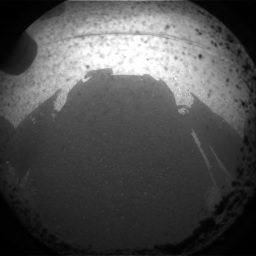
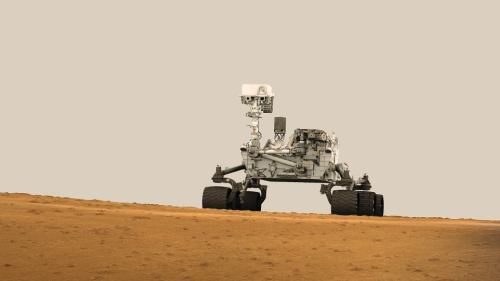
Here’s what it might look like if you were there right now.  Curiosity is safely on the surface of Mars!  After a 7 minute landing program that took the lander from 13,000 MPH to a soft landing, the first pictures have been downloaded.  Science starts soon!


Photo: Mars Curiosity/NASA

The parachute popped exactly right.  The retro-rockets fired perfectly, bringing it to a hover over the ground, then dropped it to the ground on a sky crane system that has never before been attempted.  Now the rover begins at least two years of science work.

Space Cadet Jimmiejoe is jumping up and down like crazy.  I’m glad to see he’s still around.

The Lady and the Enterprise

Leave a comment

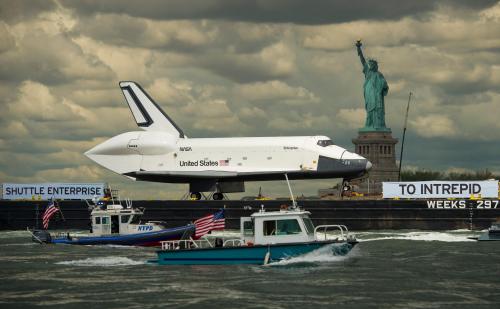
The Space Shuttle Enterprise is on it’s way to New York’s Intrepid museum by barge.  It has been lifted onto the flight deck of the U.S.S. Intrepid, the retired aircraft carrier now permanently on display in New York Harbor.  The Enterprise was the first Shuttle built, and used for flight and landing tests in the late 1970’s.  It was originally planned to be retro-fitted for spaceflight, and be the second orbiter, but structural refitting to bring the Enterprise to acceptable specifications became to expensive.  The decision was made that it would be cheaper to build a new orbiter (Challenger) than to disassemble and rebuild Enterprise.  Enterprise has been on display at the Smithsonian Air & Space Museum’s Steven F. Udvar-Hazy Center at Dulles International Airport since 2003.

More

Memorial Geek: Mars Rovers Contain WTC Metal

Leave a comment

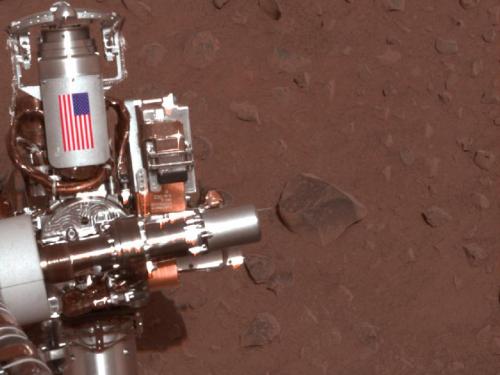
NASA’s Mars Rovers, Spirit and Opportunity, carry pieces of metal recovered from Ground Zero.  Both rovers are equipped with identical parts.  This image, provided by NASA, is of the rover Spirit, and was taken by the panoramic camera on February 2, 2004.  The piece of metal with the US flag emblem is aluminum recovered from the World Trade Center, after the September 11, 2001 attacks.

Image: NASA. Click on the image to go to the NASA site.

Earthquake Damage Report, Shuttle

Leave a comment

Atlantis lands, Shuttles retired, NASA’s next mission is… what?

Leave a comment

Space Shuttle Atlantis lands at the Kennedy Space Center, Cape Canaveral, Florida, in the pre-dawn hours of July 21, 2011.  42 years and one day after Apollo 11’s Eagle landed on the Moon’s Sea of Tranquility, the last shuttle to fly touches down on KSC’s runway 15.

It’s appropriate that this image shows the shuttle touching down in the dark, because the United States now has no manned access to space.

More

End of an era: Last Shuttle launch

Leave a comment

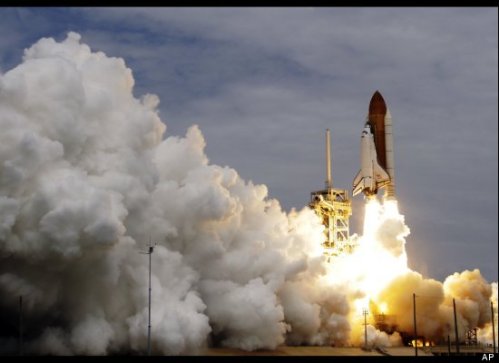
An era ends.  The last Space Shuttle lifted four astronauts and tons of supplies into the Florida sky today, enroute to the International Space Station.  The first Shuttle launch, of Columbia, occurred on April 12, 1981.  That launch was a mere 20 years to the day after the first manned space flight, by Yuri Gagarin of the Soviet Union.  In those 20 years, we went from the first dangerous launches on modified ICBM rockets, to the Saturn 5 that took us to the Moon six times, to the “space truck” that is the Shuttle.  The last Shuttle mission, flown by Shuttle Atlantis, is scheduled to land on July 20, the 42nd anniversary of Apollo 11’s landing at the Sea of Tranquility on the Moon.

Once Atlantis lands, the United States has NO way of launching astronauts into space.  We hope to have private industry doing so “soon”, but that “soon” could be a decade away.  In the meantime, we buy rides on the Russian Soyuz.  “TAXI!”


Well, dammit

Leave a comment

Dear Jim Reeves,

We regret to inform you that you were not selected for the NASA Tweetup nor the wait list. Thank you for your interest in attending the NASA Tweetup in conjunction with the launch of space shuttle Atlantis on the STS-135 mission. We value your interest in space and wish we had room to invite all 5,500+ who applied! Thank you for your ongoing support of our nation’s space program and the men and women — including astronauts living in orbit — who work at NASA.

Older Entries Newer Entries