
In 2002, to settle a discrimination lawsuit filed by a Golden West student, the ACLU, and the GSA Network, the Visalia Unified School district agreed to the following consent decree. The decree was valid until June 30, 2005, with an extension to June of 2007 if VUSD failed to complete the agreement. In it, the District agreed to the following:
- Adopt policies explicitly forbidding staff or student harassment or discrimination based on gender or sexual orientation;
- Name “”compliance coordinators”” to help parents, students and teachers with incidents of discrimination;
- Establish a community advisory group to help address discrimination and assess how the settlement is working.
It also required the District to facilitate any student requests to form a LGBT-related school club, and make the efforts to find a teacher willing to be the club’s advisor. Materials regarding discrimination and LGBT rights, staff training, student training, and protection from retaliation were parts of the agreement.
Flash forward to 2026.
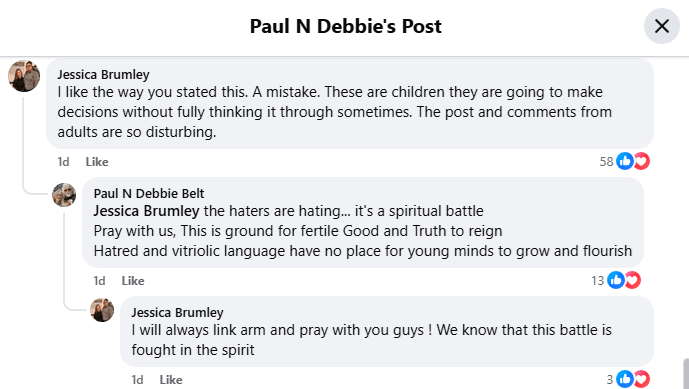
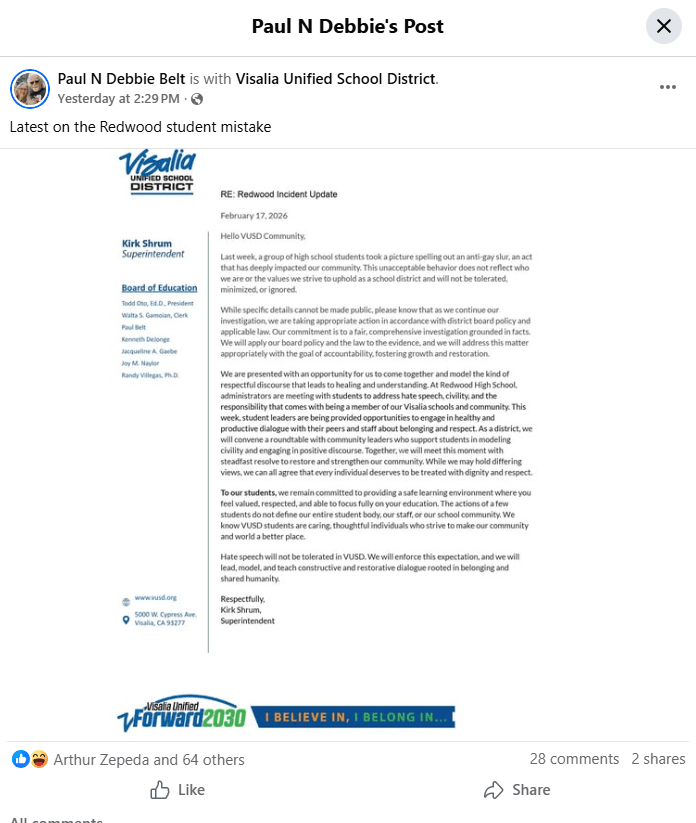
Redwood High School students, on Senior picture day, decided to arrange tshirts with letters and numbers on them to form the derogatory “2FAG60TS” seen above. Students posted the images to social media, and the community erupted. See previous posts on this blog for further information.
It may be time for VUSD to dig into their storage units and dust off the materials required by the decree. They clearly need some review.
The next VUSD Board of Trustees meeting is Tuesday, March 10, 2026. It will be held at the Board room, VUSD, 5000 W. Cypress, Visalia, California, at 5:30 pm. A large crowd is expected.
Here is the consent decree as agreed to between VUSD, the student George Loomis, the ACLU, and the Gay Straight Alliance Network.








 JimmieJoe / KC6YRU
Visalia’s Charter: Time For A Refresh
March 9, 2026
Jim Reeves commentary, News Charter City, history, News, politics, visalia, Visalia Charter, Visalia Municipal Code Leave a comment
A charter city is a municipality where the governing system is defined by its own unique legal document—a city charter—rather than solely by general state, provincial, or national laws. Visalia’s charter was created in 1923, and updated in 1974. We’re due for some critical thinking on the charter, and some updates to reflect today’s world. Much of the charter still works, but much of it also needs amending. I uploaded the Charter to Grok, and asked it to analyze the current document, and suggest things to bring it into the 21st century. Here’s what it came up with. (The current Charter can be found at the end of this blog.)
Analysis of the City of Visalia Charter
The provided Charter of the City of Visalia, adopted in the early 20th century and last amended in 1974 (with Section 21 deleted), establishes a council-manager form of government with broad home rule powers over municipal affairs, as permitted under Article XI of the California Constitution. It is a concise document (around 25 articles) that emphasizes local control, fiscal conservatism, and procedural safeguards, reflecting the era’s priorities like post-Depression financial limits and mid-century urban planning. The charter aligns with California’s framework for charter cities, granting supremacy over “municipal affairs” (e.g., elections, officer compensation, zoning) while subordinating to state law on “statewide concerns” (e.g., housing mandates, labor relations under certain statutes).
Key strengths:
Key weaknesses/outdated elements:
Overall, the charter functions but feels archaic compared to peers like San Francisco (reformed 1996, ongoing updates) or Oakland (1998 shift to mayor-council). Modern best practices, per the League of California Cities’ Charter City Toolkit and the National Civic League’s Model City Charter (9th Edition, 2021), emphasize flexibility, equity, and performance metrics. California’s 121 charter cities (out of 482 total) often use charters for tailored governance; Visalia could enhance efficiency without losing core principles.
MoreShare this: