NASA takes a bazillion photos of launches, and this is the result of digitally enhancing that data to see things usually not visible in the heat, light, and blast of a lift-off. Full details at NASA.gov.

Wit, Wisdom, and Whimsy. (your mileage may vary)
June 3, 2011
geek, Pictures digitally enhanced launch photo, Endeavour launch, NASA, Shuttle launch Leave a comment
NASA takes a bazillion photos of launches, and this is the result of digitally enhancing that data to see things usually not visible in the heat, light, and blast of a lift-off. Full details at NASA.gov.
May 16, 2011
geek, News KSC, NASA, Space Shuttle Endeavour Leave a comment

Space Shuttle Endeavour sits on the launch pad at Kennedy Space Center, an hour before it’s scheduled 25th and final flight. One more flight remains in the Shuttle Program.
May 4, 2011
geek, News Albert Einstein, frame-dragging, Geodetic effect, Gravity Probe B, NASA, the general theory of relativity Leave a comment

Artist conception - Gravity Probe B in orbit. Image Credit: Stanford
NASA has posted the following regarding the results of one of the longest research programs of it’s history. The Gravity Probe B, first conceived in 1963, and in polar orbit around the Earth since 2004, has confirmed two key predictions of Albert Einstein’s general theory of relativity.
Measurements made by the spacecraft have verified two effects of a gravitational body on space-time, the geodetic effect, the warping of space and time around a gravitational body, and frame-dragging, the amount a spinning object pulls space and time with it as it rotates.
NASA’s article provides some explanations how this knowledge will further science research, and more mundane things like global navigation and weather predictions.
April 12, 2011
geek, News Air & Space Museum, California Science Center, Charles Bolden, display locations, Intrepid Sea, NASA, Smithsonian Institution, Space Shuttle, Steven F. Udvar-Hazy Center Leave a comment
 NASA Administrator (and former astronaut) Charles Bolden, in a ceremony at one of the Shuttle Processing Facilities, announced Tuesday the locations where the retired Space Shuttle Fleet will be displayed.
Enterprise, the first Space Shuttle, used as a test platform which never went into space, will be moved from the Smithsonian Institution‘s Steven F. Udvar-Hazy Center near Washington Dulles International Airport, to New York’s Intrepid Sea, Air & Space Museum.
Shuttle Discovery will be displayed in Enterprise’s place at the Udvar-Hazy Center.
Shuttle Endeavour will be at the California Science Center in Los Angeles.
Shuttle Atlantis will remain at the Kennedy Space Center, on display at the Visitor’s Complex.
Retirement of the Space Shuttle Fleet leaves the United States without the capability to send people into orbit. Any access by astronauts will be on Russian Soyuz spacecraft. The Constellation program, which was to be our follow-up to the Shuttle has been defunded, leaving the United States hoping that successful commercial vehicles can be developed in the future. Until such vehicles are developed, at an unknown point in the future, the United States can only send unmanned rockets into space.
April 5, 2011
commentary, geek, Personal Brian Basset, Endeavour, Enterprise, NASA, Space Shuttle, What a ride it's been Leave a comment

From the first flights of the Enterprise, to the final voyage of Endeavour, it’s been a grand 30 years. Over a hundred missions, the construction of the International Space Station, the launching and servicing of the Hubble Space Telescope, and the tragic loss of two Orbiters and 14 astronauts, the Space Shuttle Program has always been a part of my adult life. It’s difficult to imagine it not being there any longer.
March 30, 2011
geek, News Mercury, Messenger, NASA, space images Leave a comment

Photo Credit: NASA
Yes, actually, that is in color. Here’s the scoop, at Bad Astronomy. (and a bigger image, too!)
March 28, 2011
commentary, geek, video Booster recovery, booster video, NASA, Shuttle launch, SRB Leave a comment
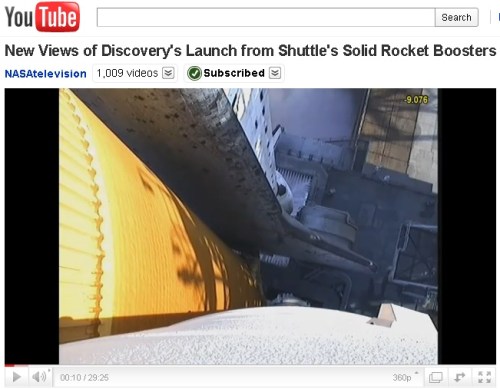 “… and the Shuttle has cleared the tower.” For the next two minutes, twin solid rocket boosters propel the Space Shuttle toward orbit. Cameras are mounted in several locations on each booster, and if you’ve ever wondered what happens to them, here’s your chance to find out. Two minutes of powered flight, separation from the Shuttle and main fuel tank, four minutes of fall, and then splashdown in the Atlantic Ocean.
Here’s what it looks like to a really tough fly on the wall… er, booster.
March 8, 2011
geek Discovery, NASA, Space Shuttle wake up call, star trek, William Shatner Leave a comment
March 7, 2011
commentary, geek, Personal Discovery, ISS, NASA, Space Station, transit, visalia Leave a comment
 Actually, they didn’t come from outer space. They came from Earth. Florida, to be exact. It’s a bit much to even say they are in “outer” space. They were just a couple of hundred miles from me tonight. That’s closer than friends in the San Francisco Bay area. In fact, they were closer to me than most of the rest of humanity, right at that moment. But they were in orbit, and I was standing in my driveway in Visalia, California.
I didn’t take this picture. It’s not of the sight from tonight. It gives only an idea of what I saw streaking across the sky above my home. Two points of light (streaks here due to shutter timing) floating silently overhead. The Space Shuttle Discovery, followed by the International Space Station.
I subscribe to a service that will send me a message by Twitter about Space Station transits viewable from my home. Today’s message told me a “very bright” ISS would be visible. I set the alarm on my iPhone. They neglected to mention that it would be a double whammy on this pass!
It was, literally, a once-in-a-lifetime event. I can’t begin to describe how I felt as I saw it.

 JimmieJoe / KC6YRU
Mars Geek: Spirit Gives Up The Ghost
May 25, 2011
Jim Reeves commentary, geek, News Curiosity, Mars, NASA, Opportunity, Spirit rover Leave a comment
Transmissions to the Martian surface from Earth, and from orbiting relay stations have failed to elicit a response. Age and the terribly cold Martian winter have finally silenced the science lab on wheels.
The next generation rover, Curiosity, is nearing it’s launch date, and NASA must reconfigure Earth bound transmission arrays, as well as the satellites orbiting Mars, to support the new mission. Spirit will stand silent sentinel near Gusev crater now, slowly collecting a layer of Mars dust, waiting for the day when humans arrive to reclaim the sturdy little machine designed to operate for 90 days. Landing January 5, 2004, Spirit studied Mars for 6 years. Perhaps, someday, we’ll collect up Spirit, and return it home. An honored spot at the Smithsonian would be appropriate, I think. It’s certainly earned that distinction.
It’s twin, Opportunity, still roves on the other side of the planet, sending science back to eager researchers on Earth.
Share this: