I wonder if this will stir up anything? You know how those Christians get when you suggest something they believe isn’t really what happened.

QN to expand national footprint (via Queer Networks)
July 2, 2010
Gay, News, Personal Leave a comment
 We’re growing steadily across California, and now the country. Who knows where we’ll pop up next?
via Queer Networks
It’s Not All Glamour and Excitement in Outer Space!
July 2, 2010
geek glamour, ISS, NASA, space toilet Leave a comment
 Scheduled maintenance of the toilet on the International Space Station. Even NASA geek has some shitty moments! 😉
Tip ‘o the flush to Twitpic via @Astro_Wheels
1/6th Gravity Geek
July 2, 2010
geek Apollo 16, John Young, one sixth gravity, The Moon Leave a comment

All-American Salute
Astronaut John W. Young, commander of the Apollo 16 lunar landing mission, leaps from the lunar surface as he salutes the United States flag at the Descartes landing site during the first Apollo 16 extravehicular activity, in April, 1972. (Try that at 1G while wearing a hundred pounds or so of spacesuit!) Astronaut Charles M. Duke Jr., lunar module pilot, took this picture. The Lunar Module “Orion” is on the left. The Lunar Roving Vehicle is parked beside Orion and the object behind Young (in the shadow of the Lunar Module) is the Far Ultraviolet Camera/Spectrograph. Stone Mountain dominates the background of this lunar scene.
Image Credit: NASA
Star Geek – Planets in other solar systems photographed
July 2, 2010
geek extrasolar planets, sun-like stars, visible light Leave a comment
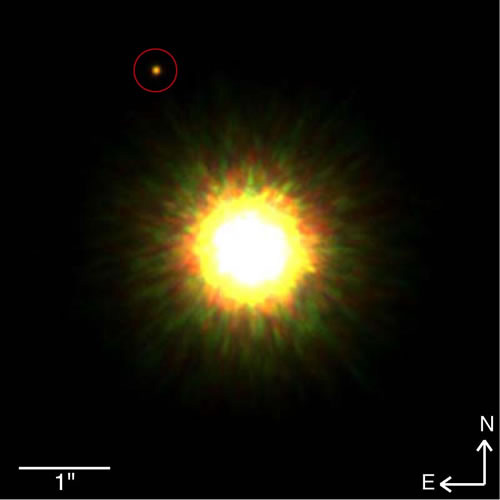
In an interesting “battle” of definitions, this is either the first visible light image of a planet orbiting a nearby star, 1RXS J160929.1-210524, or the third.
 This is an image taken in 2005, of a planet called 2M1207b. It’s about 5 times Jupiter’s mass, and is orbiting a blue dwarf star 230 light years away. Some don’t consider the blue dwarf to be a “Sun-like” star, so the quibble about ‘first planet seen in visible light orbiting a nearby star’. The image was taken using Chile’s Very Large Telescope.
 This image of Fomalhautb was taken by the Hubble Space Telescope. It shows a planet orbiting the star Fomalhaut, a star hotter and more massive than the Sun. Taken in 2004, a confirming photo was taken in 2006. It took two years of study after the second photo to confirm the planet was really a planet and not something simply in the same frame, not related to the star.
In the first image above, star 1RXS J160929.1-210524 is 500 light years from Earth, and was photographed using Gemini North telescope in Hawaii, in 2008. It wins the “first planet orbiting a sun-like star using a ground based telescope” designation, and “third planet orbiting a nearby star seen in visible light”.
Whatever the “details”, and regardless of how the press correctly or erroneously hypes it, it’s still another great moment in geek (and science!)
For a deeper explanation, by someone actually involved in the field, see Bad Astronomy Blog. Don’t worry, it’s not all science “greek” incomprehensible stuff, astronomer Phil Plait makes it understandable to the general reader. Go see!
More NASA Geek – Next Mars Rover is HUGE!
July 1, 2010
geek Curiosity, Mars rover, NASA, wheels Leave a comment
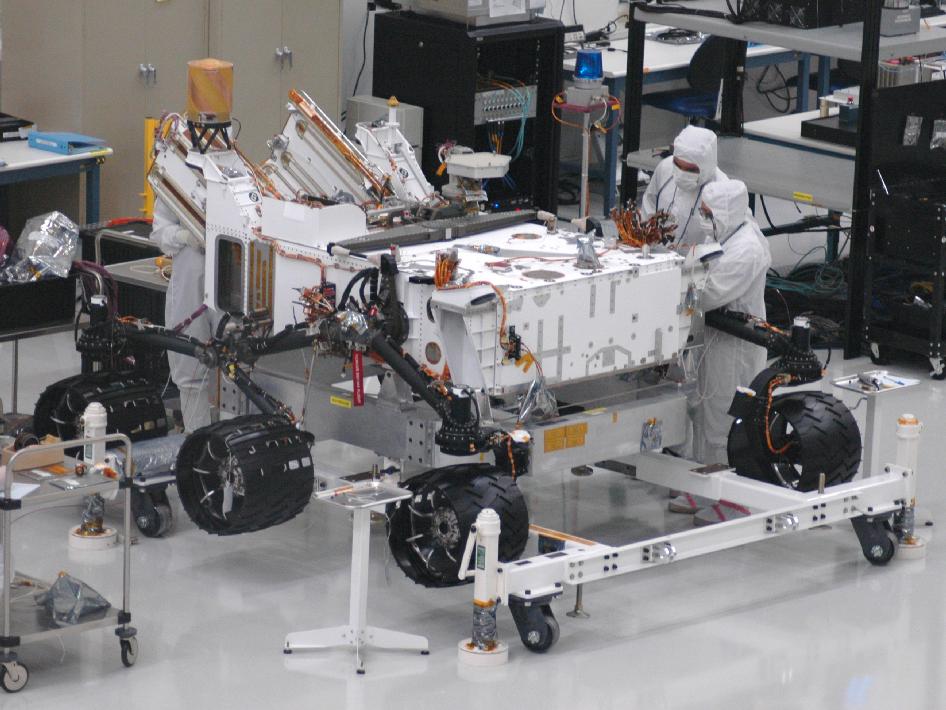 Wow… this puppy is HUGE! Mars rover Curiosity just had it’s wheels installed! Set for launch in late 2011, Curiosity is set to really explore Mars!
NASA page, here.
Toilet Geek – NASA Answers #1 Space Question
June 30, 2010
geek how do astronauts go, space potty, space toilet Leave a comment
More NASA Geek
June 30, 2010
geek NASA, voyager, voyager 2 Leave a comment
 Voyager 2 at 12,000 Days: The Super-Marathon Continues
From NASA’s Voyager Website.
NASA’s plucky Voyager 2 spacecraft has hit a long-haul operations milestone today (June 28) — operating continuously for 12,000 days. For nearly 33 years, the venerable spacecraft has been returning data about the giant outer planets, and the characteristics and interaction of solar wind between and beyond the planets. Among its many findings, Voyager 2 discovered Neptune’s Great Dark Spot and its 450-meter-per-second (1,000-mph) winds.
The two Voyager spacecraft have been the longest continuously operating spacecraft in deep space. Voyager 2 launched on August 20, 1977, when Jimmy Carter was president. Voyager 1 launched about two weeks later on Sept. 5. The two spacecraft are the most distant human-made objects, out at the edge of the heliosphere — the bubble the sun creates around the solar system. Mission managers expect Voyager 1 to leave our solar system and enter interstellar space in the next five years or so, with Voyager 2 on track to enter interstellar space shortly after that.
Having traveled more than 21 billion kilometers (13 billion miles) on its winding path through the planets toward interstellar space, the spacecraft is now nearly 14 billion kilometers (9 billion miles) from the sun. A signal from the ground, traveling at the speed of light, takes about 12.8 hours one-way to reach Voyager 2.
Voyager 1 will reach this 12,000-day milestone on July 13, 2010 after traveling more than 22 billion kilometers (14 billion miles). Voyager 1 is currently more than 17 billion kilometers (11 billion miles) from the sun.
The Voyagers were built by JPL, which continues to operate both spacecraft. Caltech manages JPL for NASA.
For more information about the Voyagers, visit: http://voyager.jpl.nasa.gov/.


 JimmieJoe / KC6YRU
Climate Geek – Climategate’s death rattle
July 1, 2010
Jim Reeves commentary, geek Climategate, Global Climate Change, Global Warming Leave a comment
Climategate’s death rattle.
Another independent review clears the scientists involved. Climagegate is nothing more than wishful thinking on the deniers part. Give it up, dudes.
Read the blog at Bad Astronomy.
Share this: